Saturday, July 5, 2014

Some final pictures from Cortona

We spent our last day in Cortona in the walled city. We visited the diocesan museum, which has some incredible paintings, frescoes and other decorations that have been gathered from various local churches into this museum for safe keeping and convenient viewing. We were among very few visitors, and enjoyed some undistracted, unhurried time there.

Lamentation over the dead Christ, by Luca Signorelli--1502

Annunciation, by Fra. Angelico--1434-1436

The Chapel downstairs with frescoes, peace and quiet.

A rest on the steps in the piazza. Cortona is steep!

Our walk down the narrow road to our B & B in Camucia.

Thursday, July 3, 2014

Montalcino, a 1200 year old community of prayer, and a drive in the country

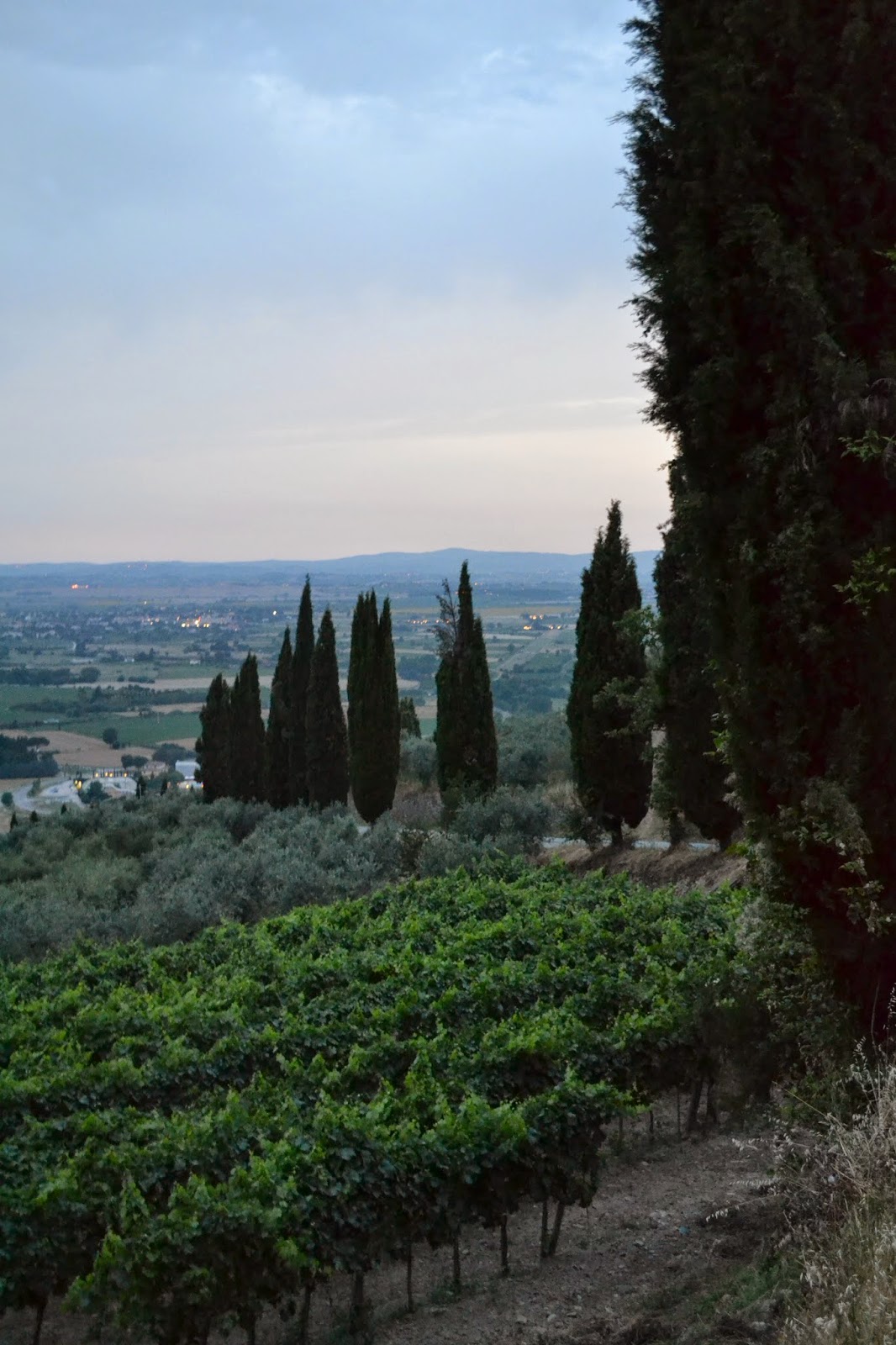
Part of what we have seen, though not photographed, is the incredible countryside beauty of Tuscany. The scenes we generally associate with this region of Italy appear most often in a sub-section of the region called Crete Senese (CREY-ta Se-NAY-zee).  Today we drove through this portion of Tuscany on our way to Montalcino, the smallest of the medieval cities we have visited. Siena is the largest, followed by either Cortona or Montepulciano, and then Montalcino.


We started our journey, and stumbled across a huge field of sunflowers. We had seen some of these fields on the autostrada, but at 110 kilometers/hour, they are hard to photograph clearly! Our girls hopped out for a quick snapshot. All sunshine and light!

After taking that picture, Furman wanted to stop on the side of the road everywhere to take pictures of the pencil-shaped trees, vineyards, olive groves, and blue sky. Unfortunately, it was difficult to find a stopping place on the narrow highways that were not actually the driveways to homes and farms. But, the back seat crowd took over, and snapped some photos as we drove along, including one of the determined driver. His nickname—‘Mario’—befits his slightly out-of-practice manual transmission driving, enhanced by his dogged determination to embrace the curves, hills and blindspots. (We now know why bright yellow is such a popular color for cyclists’ jerseys, and it has nothing to do with the Tour de France. It is all about being seen!)

Montalcino is one, laid back town. The economy revolves around its delicious wine. ‘Brunello’ (brunette) wine is so called for its dark color. It is made of 100% Sangiovese grape—a big, sturdy grape that makes possible a long aging process to tease out subtle flavors and characteristics.

Our girls were so charmed by the 3-wheeled trucks. Katherine informed us she would like one for Christmas, preferably in a light pink or turquoise green (which we really did see). We have joked about how Dodge Trucks might be built ‘ram tough,’ while these Italian trucks are built ‘Chihuahua tough.’

After the long trip to Montalcino, and several hours and gelato scoops later, we decided it was time to turn back for Cortona. Fortunately, we made a wrong turn leaving town, and proceeded in the opposite direction. Thus, we found ourselves approaching the Abbey of Sant’ Animo. Our Bed and Breakfast host told us about this monastery, and since it was only a few more kilometers out of the way, we pressed on. It was so worth it!


Originally built in the 9th century, this abbey predates the schism between the eastern and western Church in 1054. The current church dates to the 12th century, and was built upon the site of the original church. The crucifix—life size—behind the altar dates to the mid 13th century.  It was quiet, cool and dark in the nave, with very few visitors. 

There is a crypt under the altar. A fresco on the wall depicts the resurrection of Christ, assisted by angels, with visible wounds from the nails and spear quite evident.


Furman was permitted one ‘photo stop’ on the way back home since the landscape image he was looking for was easily captured from the grounds of the abbey.

Montepulciano

Medieval city meets satellite TV!
Today was comprised of driving in the Tuscan country, and a visit to the walled hill town of Montepulciano. Montepulciano is a lovely town, and it has a name that is really fun to say! (Mon-te-pool-chee-AH-no).

In addition to being a beautiful, historic medieval city, Montepulciano also boasts a laundry mat. So, we took our dirty laundry with us, and, with the help of the postman, we found the launderette tucked away in a crevice of historic buildings. God bless him for helping us, despite a fairly hilarious language barrier, in finding what we needed!

The laundry was about 1700 feet above sea level. We put clothes in the washer and descended to a cafĂ© about 1300 feet above sea level. After lunch, we climbed back to move clothes from washer to dryer, and then visited the main piazza at about 1850 feet above sea level -- and a side trip to a wine cellar.  Then, it was back down to the dryer to pick up clean, dry clothes.


At the city's annual festival, competing neighborhoods push full wine barrels uphill in the city streets in a race. I imagine they work up quite a thirst!

Historic well in the main piazza, complete with pulleys.

One of the secret passageways and escapes (this one found in the lower level of a shop that sells soaps and candles)!

Wednesday, July 2, 2014

Assisi, and then Cortona and Siena


On Monday we visited the Church of St. Francis and the Church of St. Clare in Assisi. They are both special places, and even though I would have loved to have taken some pictures of the frescoes and altars, the 'no photographs' and 'silence' signs helped preserve a peaceful atmosphere for those who come to visit and pray.

Here are a couple of other images of exteriors. They are notable for just how plain and simple they appear--which is, after all, part of the rule of life for Franciscans and Poor Clares!


In the afternoon, we caught the train from Assisi, in the region of Umbria, to Cortona, in the neighboring region of Tuscany. We are staying a couple of miles outside the walled city, at the base of the hill (and it is quite a steep hill). After enjoying this beautiful sunset from the walled city, we walked down the steep hill after dinner to our B & B with the light of this crescent moon (and our flashlights)!


On Tuesday we rented a car and set out for Siena. We just happened to arrive on the day before one of two big horse races that happen each year (one in July and one in August). They pour dirt into the main piazza and create a 'track' that is roughly 1/3 of a mile. The city is divided into neighborhoods, which have flags, scarves, and lots of team spirit. The winning neighborhood gets bragging rights for the year to come! We were caught up in the excitement of the crowds, and were thankful to arrive on the day of the trials rather than the day of the race, when more than 60,000 people will be crammed into the central square! We drove back to Cortona for dinner, and another breathtaking sunset from the old city!


Sunday, June 29, 2014

Arrival in Assisi

We caught the train out of Sorrento with 15 seconds to spare!!! Our other two connections--in Naples and Rome--were also very close! The angels were traveling with us today!!!

We arrived in Assisi late this afternoon. What a beautiful city!

We stumbled across a festival procession of the Blessed Sacrament from one of the local churches. Also, the sidewalk outside our apartment was filled with creative designs using flowers and grasses. After dark, the children got to mess it all up!


More pics from Pompeii and Sorrento

Pictures from Pompeii and Sorrento
Pompeii Cast--Obviously a final posture of prayer.

Inside the Public Baths in Pompeii near a font.

Quite well preserved wall frescoes in Pompeii ruins.

A street wide enough for wagons, with ruts, curbs, etc.

Moorings along ancient sea wall. Now, earth, trees, and still Mt. Vesuvius in the background.

Mt. Vesuvius at night from our balcony in Sorrento. (The city lights of Naples and suburbs almost look like lava at the base of the volcano. This is Europe's only active volcano.)

A little break at the lemon grove in downtown Sorrento!

A view to the Adriatic Sea from Sorrento.

Inlaid wood artistry is a traditional, local art form. In one of the churches is this nativity scene--no painting whatsoever!

This bell from St. Anna's Church just outside our apartment chimed every 15 mintues--from 5 a.m. until midnight!

Saturday, June 28, 2014

Pompeii and Sorrento


BLOG—Pompeii and Sorrento

We kept a pretty hectic pace in Rome for five days, and we decided to ‘grind out’ a long day’s travel to southern Italy on Thursday. Up at 5:30 a.m., we exited our apartment by 7 a.m. with only a few small cups of coffee under our belt (the percolator only made one cup at a time). We were extremely fortunate to find a taxi that would seat five -- and hold our luggage. We made it to the train station in record time, so perhaps we could have slept in a bit longer...

The train to Naples took several hours—one more than described on the schedule. In the Naples station we finally found the toilette, and the one Euro coins necessary to unlock the turnstile. It seemed I had every other denomination of paper and coin currency, and the change-making machine was not working at its optimum!

After picking up some ‘station food’—Panini’s and sandwiches with splendid cheeses and prosciutto—we descended the steps to the ‘local’ trains which circumnavigate Mt. Vesuvius. We bought our tickets and packed into the small, crowded train where we stood for the next 45 minutes until our arrival at the station for the archaeological site for ancient Pompeii.

Blessedly, the site offers free baggage storage! We spent a couple of hours winding our way through those ancient streets, and seeing a city that was frozen in time and amazingly preserved—including 2000 year old frescoes in the homes of some of its wealthy citizens. In terms of seeing (and imagining) an ancient city from the basis of its archaeological remains, Pompeii may offer the best, large-scale footprint (and wall print) of any that I have seen—complete with ruts in the streets where chariot and wagon wheels rolled for hundreds of years until the eruption. 2000 year old lead pipes were evident along one street. Cooking ovens, courtyards, and casts of frozen bodies all helped shape an impression of coastal life at the foot of Italy’s southern mountains.

We picked up our bags as we returned to the station. Five tickets and five minutes later, the small, local arrived at the platform (great timing!) and we stood for another 45 minutes to Sorrento. The train was not as crowded, and the anticipation of arriving at our destination kept our spirits high, even though our feet continued to feel sore nonetheless.


Arriving in Sorrento, 12 hours after we started our day, we exhaled into the gentle breezes that whispered through palm trees and lemon groves in this city built along the cliffs that drop into the sea. Our landlord arrived to meet us at the train station, and we took a taxi through the winding streets, and down to Marina Grande. The apartment we have rented for several nights is in the middle of this little cove of buildings and boats. Unlike Rome, our apartment was at the top of only four flights of good, sturdy, marble steps!

Part of the theory of booking apartments at the tops of the buildings was that in addition to great views, and good prices, we could ‘work off’ some of the calories we were taking in. I guess all three of those things were true, though any evidence of the ‘calorie burning hypothesis’ was hard to see. The abdominal muscular ‘six pack’ I never had is being transformed into a ‘12-pack’ within one of those Styrofoam coolers with soft, rounded edge! The endless miles, steps and sunshine are no match for the delicious, fresh foods of Greece and Italy!