Sunday, June 15, 2014

Flying Down the Mountain and Final Day @ Meteora

               Descending and ascending all the steps into Great Meteora Monastery is no small chore. Walking down the blacktop highway 400 meters to Varlaam Monastery, in full sun, is guaranteed to take its toll. The last few hundred stairs and steps into/through/and back out of that monastery put us all in a mood to find two things:  five ice cream bars and a taxi back to Kalambaka for lunch! (In that order—sometimes you need to eat dessert first!)

               As we purchased the ice cream bars, we noticed a vacant taxi nearby. Not knowing who the driver was, we inquired with the ice cream vendor, who understood enough English to help find the driver. It is not easy to find taxis up on the cliffs. Although plentiful in the valley, most drivers do not linger in hopes of finding a fare back down. The few drivers who park and remain outside the monasteries, do so because they have clients inside who have paid a steep premium for the taxi to wait for them, and take them either to the next monastery or back down the mountain.

               We suspected that the driver who came forward to offer us a trip down had other clients inside, because he watched attentively as we finished our ice cream bars, and he was ready-to-go as soon as we were! He clearly needed to get us all the way down and return back up to Varlaam before his unsuspecting clients exited the monastery and wondered where their driver went. I say ‘clearly’ because he sprinted out of the parking lot with breath-taking acceleration.

               As hot and tired as we were, and, as good as the wind coming through the windows felt, we nonetheless all wondered silently if we had made a mistake. The curves and bends in the road down the mountain are quite dramatic, as was his negotiation of them. As we swerved around one hairpin turn, there was a big, lumbering 2-story bus just inching along.  Hallelujah! we thought as we were forced to creep at a much more calm and reasonable pace through several switchbacks in the road.

               But, this calm was not to last.  Claiming a brief straightaway of no more than one additional bus length, our driver saw his opportunity to reclaim his Grand Prix finesse.  By now—no doubt—he was feeling obligated to make up the time lost, not only to the precious moments while we finished ice cream atop the cliff, but also for the time during which we were stuck behind the slow bus!

               We did arrive safely in Kalambaka, and watched as our driver sped back up the road to Varlaam (probably with time to spare)!
Today, we planned a different itinerary with the hours available to us in Kalambaka before our train departure for Athens at 5:30 p.m. Having visited four of the six monasteries, we decided to walk some of the trails around portions of the cliffs, and search for some of the caves along the way.             
We caught a taxi to Kastraki, a small village about half way up the cliffs. From there, we found a trail through what appeared to be an abandoned field. At the far edge of the field, along a line of trees, and approaching within 50 meters of the towering cliff, the temperature dropped by 10 degrees in a matter of one or two steps. It was like walking from the sunny parking lot straight into the dairy/frozen section of a grocery store! Under these conditions we felt like we could hike for miles!
A little further along, we could look up and see a cave filled with prayer flags. Apparently, some of the villagers in Kastraki ascend the cliff once a year to change out the flags with fresh ones. It obviously requires both equipment and nerves that our family lacks, so we made a few token steps up the cliff face for a photo to make the point!               
A little further along was a small chapel. It was locked, but there was a nice, shaded patio and so we circled up and said Morning Prayer together, using the lessons for Trinity Sunday.
From this point, the most conspicuous trail seemed aimed toward the Monastery of St. Nicholas. Even though it appeared to be a fairly short distance away, it did seem like a mile up! Not having another trail choice, we accepted the challenge and began our ascent.
This is the smallest of the monasteries we have visited. It has a small chapel, literally carved out of the rock below the entrance. And the layout is much more of a nook and cranny, vertical experience than a sort of plateau architecture across the top of a cliff. I believe a stone near the door indicated its founding was in 1520.
Given the small size and steep climb, this was not a popular monastery with the tour buses. In fact, there was really no place for those super-size buses to park here. We had a peaceful visit, and lingered on the pinnacle of the rock until we heard the thunder of an approaching storm, and took stock of our proximity to the flag poles next to the bell tower!
We hiked back down to Kastraki, and found a traditional Greek tavern with covered outdoor seating just as the first rain drops fell. We enjoyed a delicious meal, and then called a local taxi (not from the Varlaam parking lot) to get us back to Kalambaka.
After resting in the lobby of our guest house for a couple of hours, the rain stopped, and we trekked to the nearby train station. We had about 25 minutes before departure, and so Katherine and I ran up the hill (literally) to the main café and restaurant area of town to look for some sandwiches for our five hour train ride. We found some Greek fast food, made the purchase, and ran back downhill to the train station with 10 minutes to spare!
Everyone else had loaded all the backpacks onto the train (probably getting just as much of a cardio work out as we did) and we settled into our small ‘Harry Potter-like’ compartment for the ride to Athens. This was a delight for the girls, who are enjoying their very first passenger train ride today!


Saturday, June 14, 2014


This morning we visited the Great Monastery of Meteora (a.k.a. Transfiguration) and Varlaam (a.k.a All Saints). One thing I cannot remember if I mentioned in the previous two posts about the monasteries, is just how violent much of the iconography is that is written onto the walls, ceilings, and arches of the Churches. I believe this reflects the high value that the Orthodox Church places upon the martyrs (the Greek verb from which we get the noun ‘martyr’ means witness, and—of course—the ultimate witness is one which is expressed with one’s life).
We can hear echoes of this accentuation in our own Eucharistic Prayer D, which is particularly inspired by the Orthodox liturgy (The American Colonial Church struck a compromise with the Scottish Bishops in order to get Samuel Seabury ordained as our first bishop. They agreed to include some of the Orthodox prayers in the first American Prayer Book of 1789.) Some of you will recall the words from the climax of Prayer D—which we use during the Easter Season at St. Peter’s—where we join our voices with “…prophets, apostles, martyrs…”.
Indeed, one can see the robust sense of communion that Orthodox Christians experience with all the saints. They will typically kiss one of the icons as they enter a Church, not reverencing the object itself, but the Christ and faithful forebears to which these icons direct our attention.
The Great Monastery of Meteora has an ossuary near the entrance. This room contains the skulls and bones of monks who have died, along with candles, and an icon of the Resurrection. From the earliest centuries of Christian faith, those who have died have been buried in and around churches in anticipation of the resurrection of the body (not just soul) as attested in the Nicene Creed. Setting aside a special place for the bones of these saints within the community is somewhat like having a sacred place for the interment of ashes in our Church.
There was also a cellar with relevant artifacts organized and displayed throughout the space. Notice the substantial number of barrels.  It is apparent that one can work up quite a thirst laboring and praying atop the cliffs of Meteora.
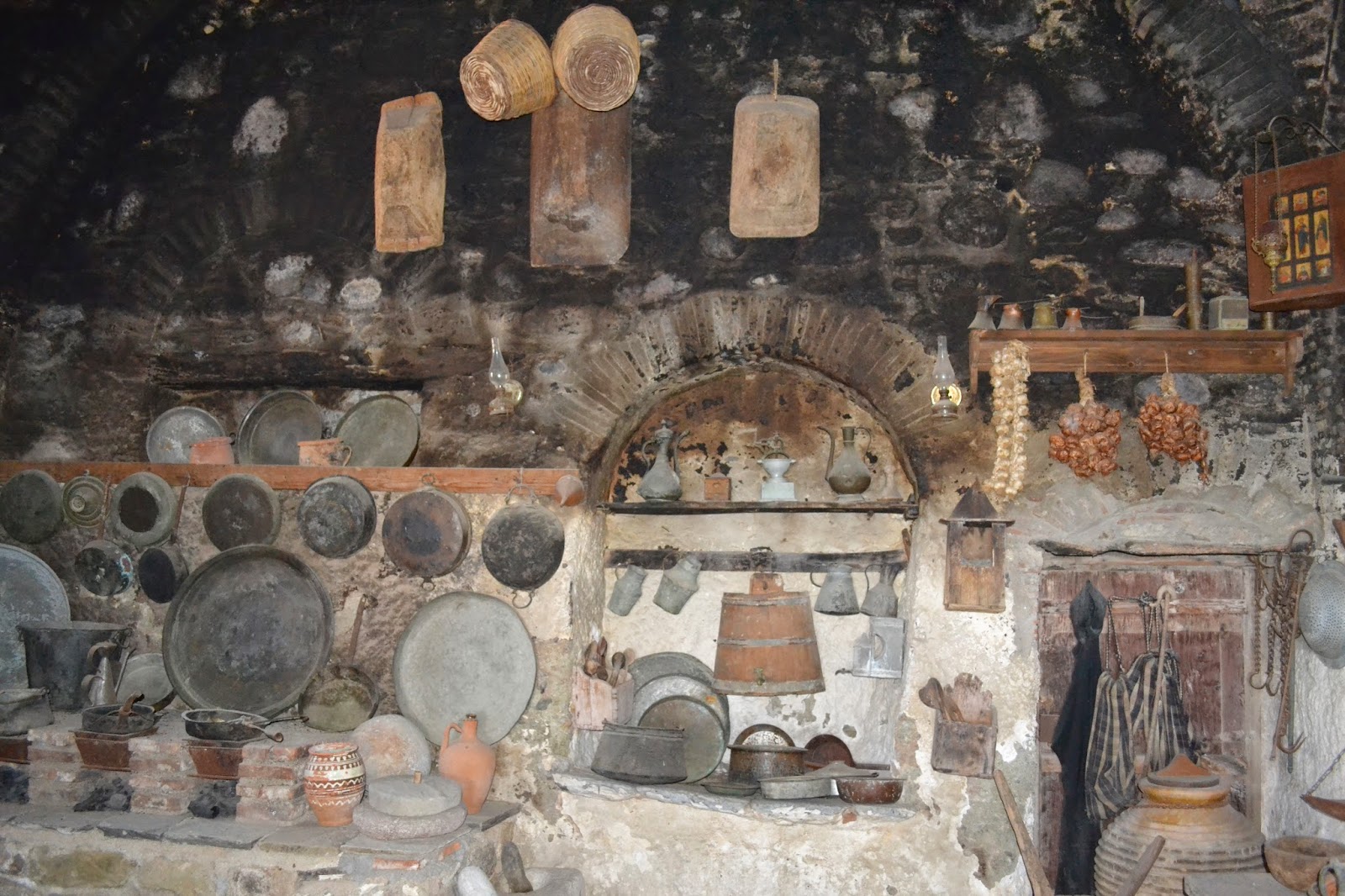
Katherine paused at the door to the original kitchen. It also included a display of original artifacts and several hundred years of soot on the ceiling from the fires that cooked the community’s meals each day.
                                              
The gardens were also beautiful at the monasteries we visited today.  


Friday, June 13, 2014


There were fewer visitors to Holy Trinity Monastery. We made our descent from the road, and then ascended the next cliff. Thankfully, for the acrophobic in our group, the steepest parts of the stairwell with the largest drop off were well enclosed!

A large metal door seals the perimeter a hundred feet or so below the monastery. Once one passes through this door, there is still a bit more climbing to do toward the gate, where a volunteer takes a donation, and points to the skirts available for those whose dress requires additional modesty.

One of the trademarks of this monastery is the balcony with a hook and rope, attached to a larger-than-life spindle, which was used traditionally to hoist monks and supplies up and down. We could still see the cart with the net, and even grooves in the stone floor where the cart was rolled to the ledge for lowering. Talk about having faith in one another! The reason this balcony and pulley is a trademark is because Roger Moore was filmed here in one of the earlier James Bond movies.

Moving on from the balcony was a wide inner hallway with small windows. Along the west wall were tiny cells where the brothers would have lived in earlier times. One was open for visitors to inspect. Notice the remaining image of a cross on the ceiling, the first thing the faithful would see upon waking, and the last thing he would see before sleeping. There was a small window, and other images painted onto the walls.

The hallway was spotless, and featured three icons recessed into the masonry. The first one was of John the Baptist (who came first in Holy Scripture). Then, Christ on one side of the passageway and Mary, the God-bearer (Theotokos) on the other side. Notice how even the masonry above the icon ‘adds’ a radiant halo above them.

After climbing a few more steps into a dark and narrow area, we reached the entrance to the Church. Once again, photos inside were prohibited, but I did take this picture, just outside the entrance, of candles that visitors light as an outward and visible sign of their prayer as they enter the Church.

Once again, we took some time as a family to sit in silence and absorb the experience. The iconography was simply all-encompassing. One of the girls noticed images from Holy Week, particularly one of Peter’s denial and the rooster perched nearby to signal three times what Jesus foretold. (How I wish I could have taken just one picture!) Beside this was another icon showing the story of Judas’ kiss of betrayal.

The gardens were not as extensive at Holy Trinity Monastery. There was a rock outcropping with a large white cross (the only visible element of this particular monastery when looking up from Kalambaka). There was also a bell tower, and just outside one of the windows was a cluster of Easter lilies in full bloom!

After leaving the monastery, we got ready to begin our descent along the pathway through the woods that leads back down to Kalambaka. We paused from time to time to catch our breath, look back up at the cliffs, and yield to a turtle and, then, a snake, which were crossing the path.

We were reminded of Psalm 95, which serves as one of the Introit Psalms for Morning Prayer (BCP, p. 80). These sacred places of worship, built upon the rock, provide a fitting contextualization for this psalm:


“Come, let us sing to the Lord; let us shout for joy to the Rock of our salvation…In his hand are the caverns of the earth, and the heights of the hills are his also. The sea is his, for he made it, and his hands have molded the dry land.

Come, let us bow down, and bend the knee, and kneel before the Lord our Maker. For he is our God, and we are the people of his pasture and the sheep of his hand. Oh, that today you would hearken to his voice!”


This morning we set out from Monastiri Guest House, took the path that the local neighbors have created to shortcut across the train tracks, and hiked uphill into town. This has nothing to do with ascending the cliffs of Meteora; just getting to the central circle of Kalambaka, and the line of available taxis is quite a hike! This is made even more so, when the slightly directionally-challenged leader selects a street which angles away from the center of town.

We squeezed into a taxi for the ride around to the back side of the cliffs and the drop off point for St. Stefanos (Stephen’s) Nunnery. The good news is that there are absolutely no steps to climb for this nunnery! The bad news is that this makes it very popular with tourists who don’t like to climb steps! We entered just before a group and managed to have a peaceful visit to the Church and gardens before they descended.
The temperature outside necessitates wearing shorts and t-shirts. The guidelines for modesty require calf-length skirts. Hence, the monasteries and nunneries have a supply of wrap around skirts for women to put on when entering the community. Our family borrowed some nice, navy blue and black-patterned skirts for our visit.

 The gardens at St. Stefanos are well kept, and include a variety of flowers and plants. Many of them bloom just as beautifully in our South Carolina climate.

There is a well with a bucket in the center of one of the gardens. There is also a corridor along one edge of the perimeter with an icon of the Blessed Virgin Mary written into a small covered space and a cross at the corner.

 A small chapel stands at another corner of the property, fronted by a rose garden and a cedar tree that provides beautiful shade from the mid-day heat.

In one of the covered hallways, there were a couple of icons written onto the wall. One was of St. Michael the Archangel. The other icon includes the Blessed Virgin Mary and a group of women. My Greek vocabulary has slipped to the point that I will need to look up some of the words describing this scene in order to have a complete understanding of the image.

Photos and videos were strictly prohibited within the Church and the museum. I did take a picture of the wooden board, which is swung into the column as a call to worship. This, rather than a bell, imitates the Scriptural reference to Noah, who in obedience to God’s command, made a signal using a plank of wood to call the animals into the safety of the ark. Likewise, the sisters are called into the safety of the ‘New Holy Ark,’ Christ’s Church, for worship.

Nearly every square inch of the narthex, nave, and sanctuary of the worship space was covered in iconography. There were images of Bible stories to take away the breath of any teacher who has sought to bring these stories to life for students. There were also images from the Christian Tradition of saints—and especially martyrs—who devoted themselves to Christ and his Church. St. Stephen, of course, was one of the first martyrs (maybe the first according to Holy Scripture). In the central dome, larger than life size, was—of course—the classic icon of Christ Pantokrator, or Christ, ruler of all.

We sat in the nun’s wooden stalls which lined the perimeter of the Church. The sweet smell of hundreds of years of incense was noticeable, even though none was burning at the time we were there. A gentle breeze passed through a couple of open windows. It was peacefully quiet for a few moments as we rested in the presence of a sacred space.

One of the things about visiting a Byzantine Church or Chapel is that you know you have been to Church. The plethora of symbols and sights, sounds, and smells all combine to shape an experience of the Holy.  And, one only need to look up to see who presides over the holiness of it all.

The museum contained an impressive variety of manuscripts, vestments, and other worship-related objects. There was a 6th century page from Holy Scripture, as well as transcriptions—ostensibly completed by monastics hundreds of years ago in this community. There were prayer books dating to the 16th century with illuminated paintings on the pages to which they were opened. The museum also had a display of letters, including a 10th century handwritten letter from the Bishop of Jerusalem. Another medieval letter had a cord that must have wrapped around the parchment and secured the document with a seal.


Silver chalices, thuribles (for incense), asperges (for Holy Water), and crosses with minute carvings—both in wood and in silver—filled other glass cases. In another room were chasubles and stoles worn by priests that were hundreds of years old, with embroidered detail that was beautiful. It did appear that the stoles were made in such a way that the two hanging ends came together as one—either with a small cut out, to slip it over one’s head, or with buttons so as to ‘button up’ the two halves, so that they hung centrally down from the neck across the priest’s torso.

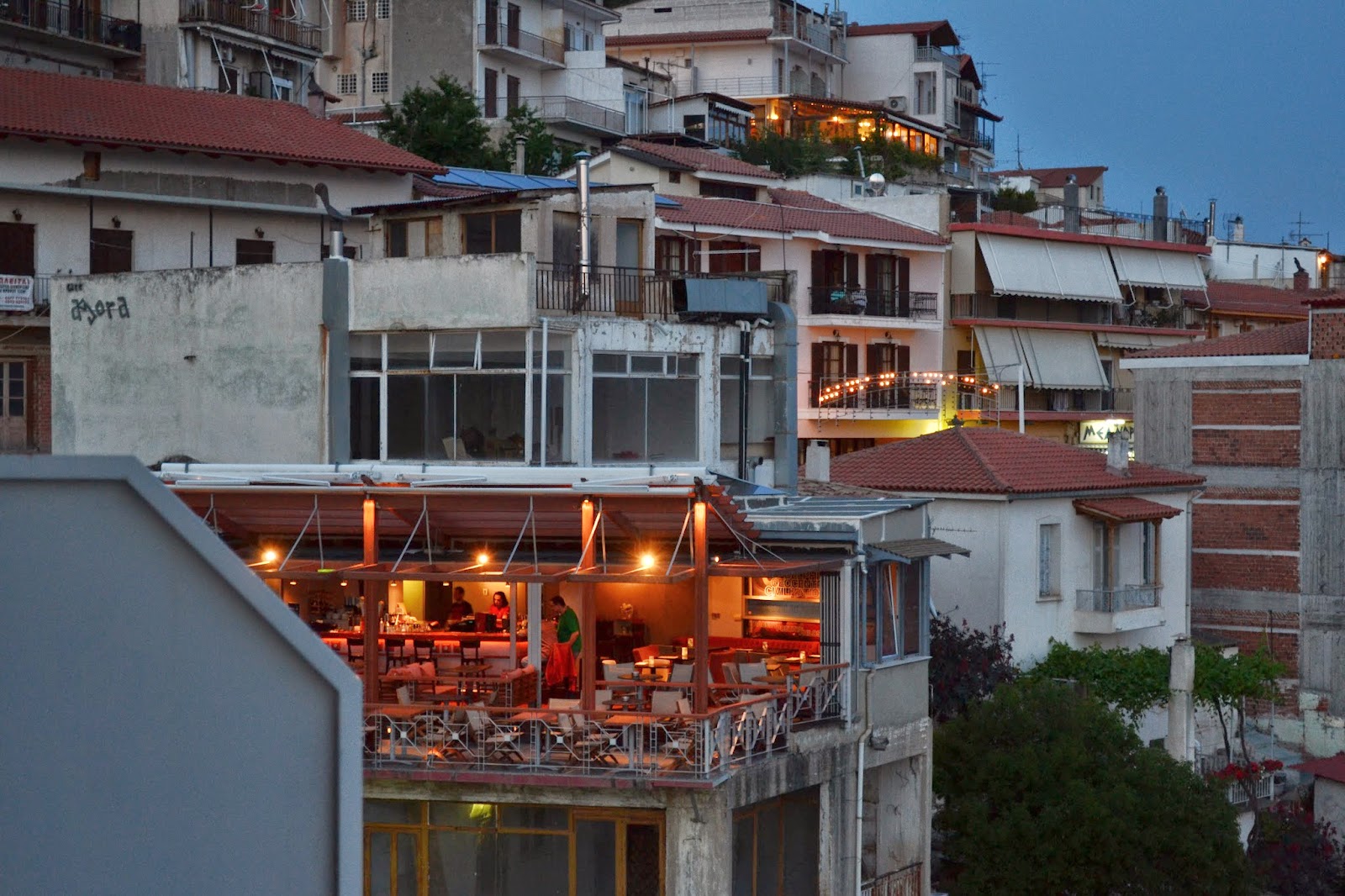
Leaving St. Stefanos, we had quite a view of Kalambaka. Ultimately, we walked all the way down a pathway that led back into town, but, first, we trekked to the Holy Trinity Monastery. Our hotelier informed us that it was 300 meters along the road, then 150 steps down, and then 150 steps back up. I am thinking she may have lost her count somewhere in her map-making, but it was still very much worth the walk!

Thursday, June 12, 2014

The Long And Winding Road


Today we woke up and put on our adventure pants!  Having enjoyed our time in Delphi, we were prepared to set off for Kalambaka to see the monasteries built into the cliffs.  Originally, we planned to take the bus, until we were told if would not be a three hour adventure, but rather an all day adventure.  In addition, some of us were coming down with a cold from the hotel's stuffy atmosphere, and were operating on little sleep.  Dad made the wise decision to splurge on a taxi, instead of pursuing what would surely be a day of major frustration.  
So, at 8 a.m., with smiles plastered on our faces, and bags strapped to our backs, we headed downstairs and into the waiting taxi.  As we stuffed ourselves into the five passenger sedan, we felt as if we were attempting to fit an unusual amount of people and luggage into one of the Weasley's magically enhanced cars (from the Harry Potter series), but without the magic. Finley, Lamar, Mom, and Katherine crowded into the backseat, practically sitting on top of each other -- no stretching charm in sight to make the seating magically expand inside the vehicle.  Uncomfortable, but happy to be taking the quicker of the two options to Kalambaka, we said goodbye to Delphi and began our journey.

One thing you need to know is that Greek drivers take almost every traffic sign as a mere suggestion.  That’s putting it lightly.  As we quickly learned, stop signs are made for tourists, not Greeks. If you don’t pick up on it by the simple fact that the stop sign does not have the Greek word for STOP on it, but rather the English version, then you will quickly discover its meaningless function, as your taxi driver speeds on through the intersection without a backward glance. However, ignorance to the road “guidelines” does not end with stop signs.  The speed limit in Greece is set at 120 KM/Hr, despite what the signs say.  If there is a sign clearly stating the expected speed limit to be 30 KM/Hr, it is wrong.  Apparently, the creator of the sign left out the one, and mistook the two he was supposed to write on the metal for a three.  If the sign clearly states 50 KM/hr, it is also a manufacturer mistake, and not to be followed.  IF there is a CLEAR red line striking through 90 KM/Hr, that only means you cannot go 90.  So, to follow this sign, it is, in the Greek way, best to stick with the established speed limit of 120 KM/Hr.

So, after a much quicker ride than expected, and some sore hips and bunkys, we arrived at our beautiful hotel in Kalambaka.  Our room overlooks the cliffs, which are home to several Greek Orthodox Monasteries (more information to come on these tomorrow).  As we had a tiring travel experience, we spent the day resting, enjoying the view, and celebrating a special dinner in honor of the missed Mother’s Day, Finley’s Birthday, and Lamar’s Graduation, as well as to mark Katherine’s sixth month anniversary from surgery and Dad’s lovely sabbatical.

Well, now it’s pretty late here, and we have a full day of cliff climbing and taxi rides ahead (we know at least one will be adrenaline filled!) so I must leave the blog here for now, but look forward to sharing more of our experiences in days to come.


Wednesday, June 11, 2014

More Fun in Delphi

Because of the area's long association with Gaia, Athena was worshiped at Delphi, along with Apollo.  The star attraction at the Sanctuary of Athena is the Tholos (c. 380 B.C.), a round structure whose exact purpose is unknown, but which is the most photographed spot in Delphi.

Here are some more shots from around the town of Delphi:


Tuesday, June 10, 2014


We awoke to the sound of a "Delphi Alarm Clock." Initially, it sounded like wind chimes singing in the breeze, which is fairly constant between these mountains. In time, we noticed that all of the different pitches of the chimes were accompanied by "baaa" sounds.  Looking out the window we  found the local goat herder transporting approximately two hundred goats and more than a few sheep (not yet separated from the goats) from one grazing area to another.

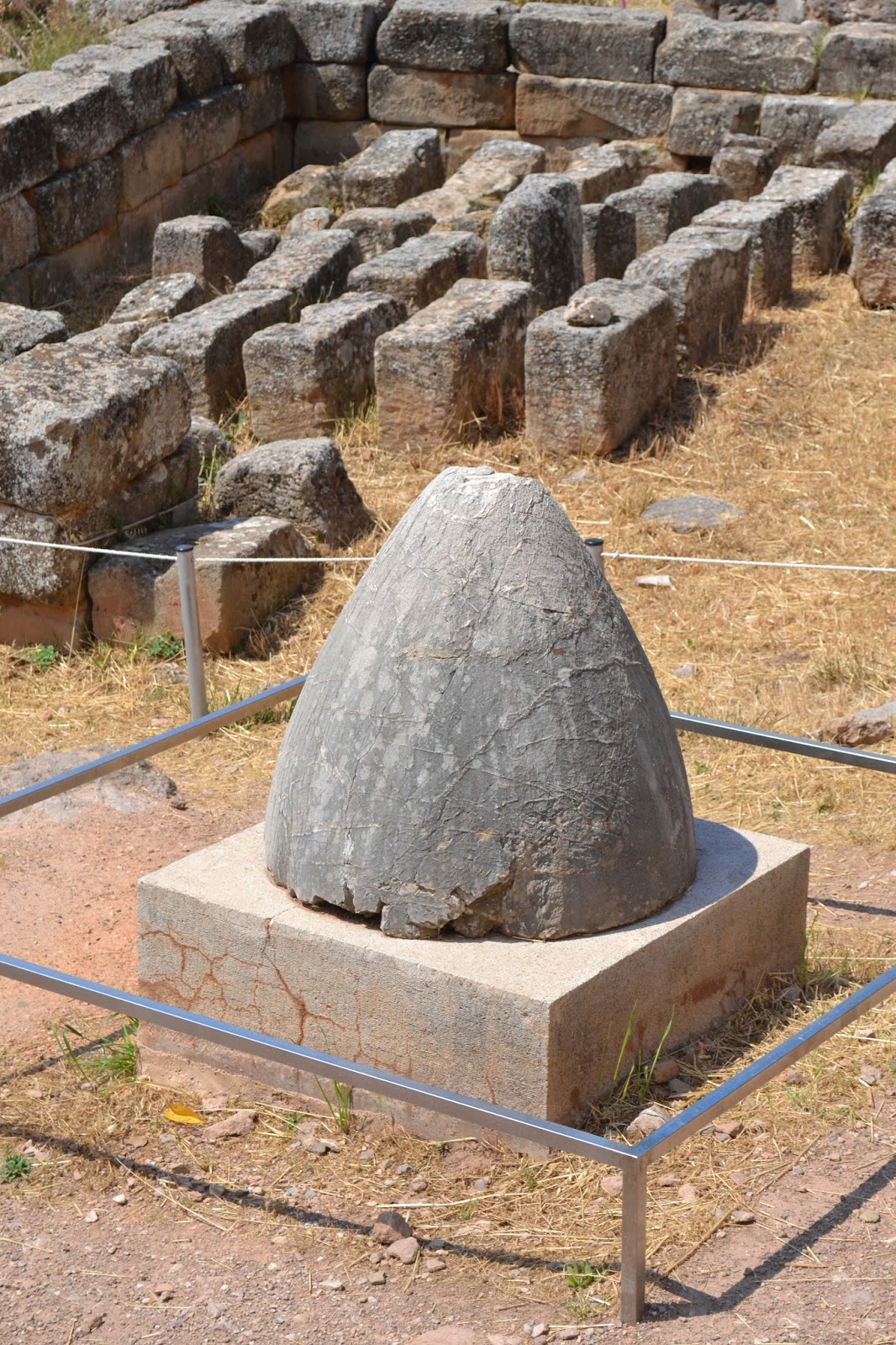
After breakfast, we trekked to the archaeological site and began our ascent up the 'Sacred Way.' In ancient times, Delphi was considered the center of the world--the place where two eagles converged after being released by Zeus to fly around the world.

This carved phallus marks the 'center' of the world.
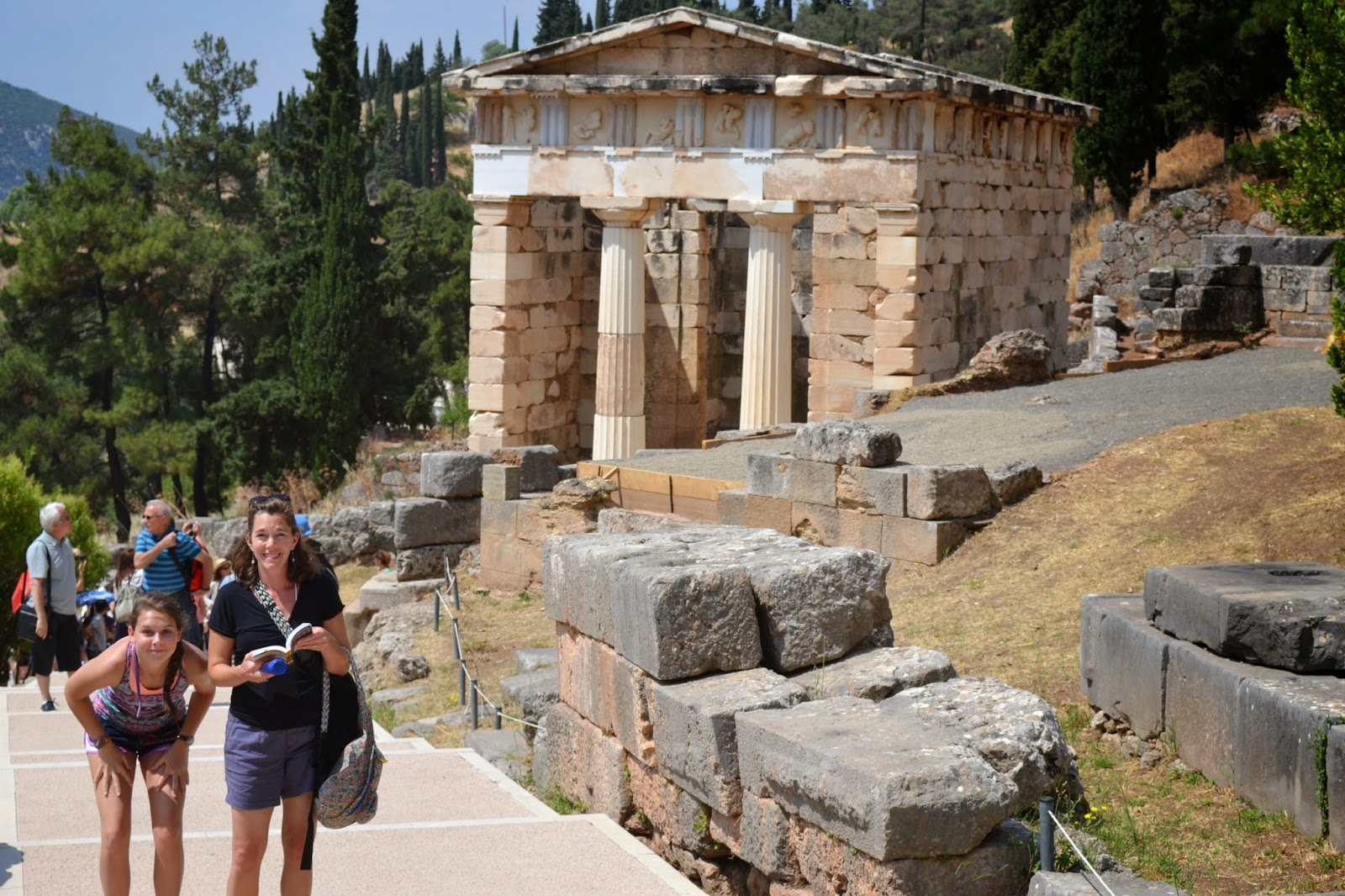
Along the pathway there are numerous outlines of treasuries where worshipers from different parts of the world would leave offerings for the gods. This well constituted example is the ancient Athenian treasury.
Leaders and even regular folks traveled hundreds and thousands of miles to consult the Oracle at Delphi. She would provide insight into the future, and her proclamations--sometimes cryptic, sometimes blunt--would be communicated with the help of priests in the Temple of Apollo.

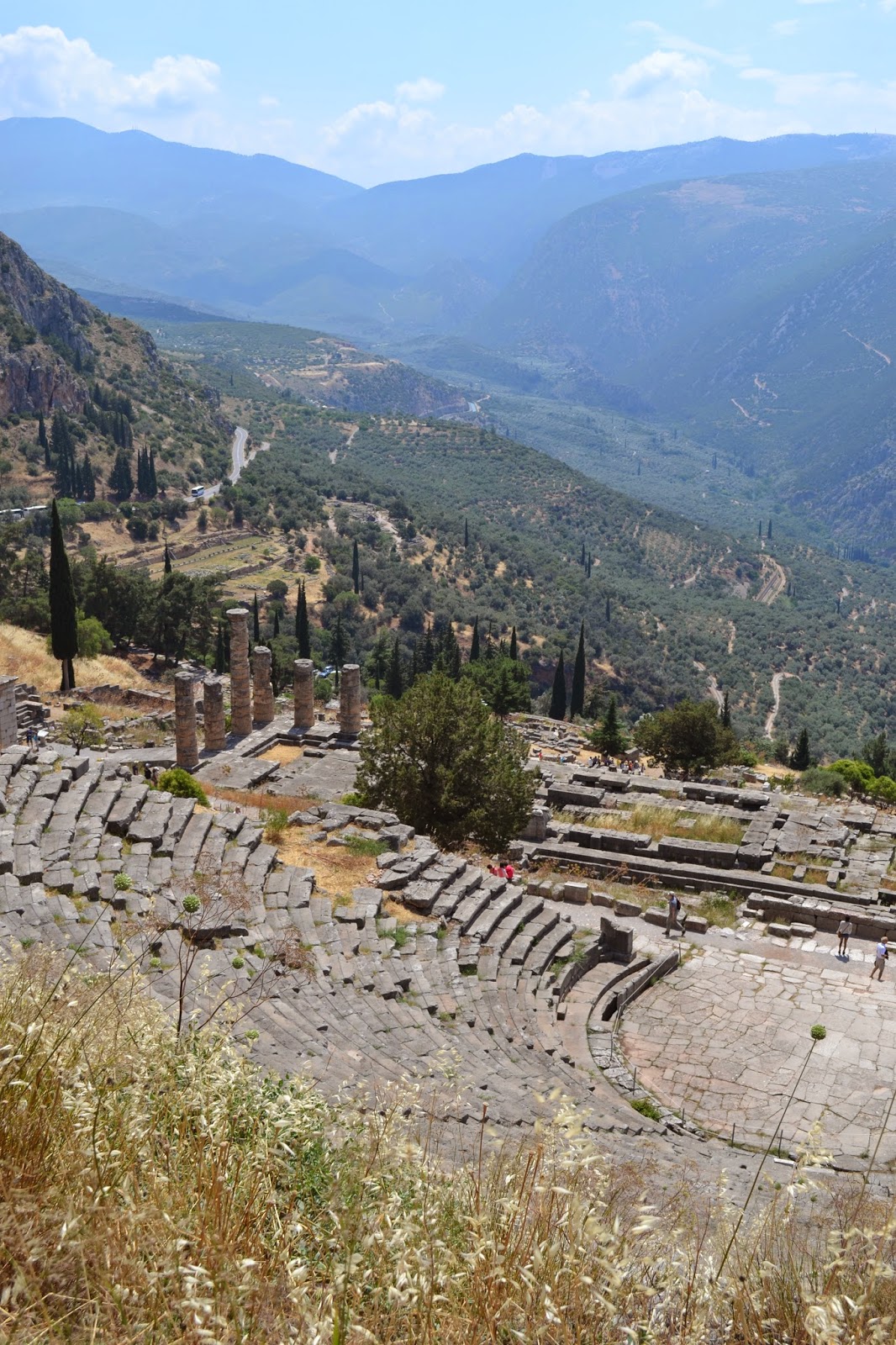
This entire area was built as a sanctuary to Apollo, and the oracle was his 'voice' in the world. Apollo loved music, and you can see in this next image that the theater was next to what is left of the footprint of Apollo's Temple. There are approximately six fluted columns still standing along one corner of the perimeter that have been in place since the 6th century B.C.

An athletic competition arose in Delphi that for a time rivaled the size and scale of the ancient Olympics. At the very top of the pathway was a stadium (only the best athletes would have any breath left after climbing this mountain to the stadium location--we can all attest to that!!!). There are still discernible marble lines for the starting/finish line. There is also a clearly differentiated bench at the midway point in the stadium built for 7,000 which was the location for the judges or dignitaries. Our girls had some disagreement about which way to be 'on your mark'!
We had a great day of trekking up and down the sacred way, enjoying the fresh breezes and sunshine, and perusing the antiquities in the very well designed and stocked Delphi Museum. Many of the Greek and Roman mythology names, symbols, and stories have come alive this week for our girls. References from the classroom, and even from the Harry Potter series, are visibly depicted in stone and through arts and crafts, and stories that come alive in places like Delphi.

When we ate our first meal yesterday evening here in Delphi, we noticed a table in the small area not designated for the middle school age tour group dining in the restaurant.  A German speaking family were seated with three boys, two of which looked to be around the ages of Katherine and Finley.  Then, at lunch today they came to the same lunch spot where we were lunching.  As we left we quipped, "See you tonight!" and enjoyed a shared laugh at our good taste in restaurants, as we headed to tour the museum.  As dinner time approached, we decided to try a restaurant our hotelier had recommended.  The restaurant consisted of two parts situated across the street from each other, causing the wait staff to traverse the street repeatedly, delivering meals, menus, and drinks.  As we arrived and settled into our chairs in the breezy outdoor plaza where we chose to sit, we looked across the street and were unsurprised to see our German friends.  When they finished their dinner, they came over and introduced themselves, laughing at our synchronicity in restaurant choices.  They were on a two week holiday and would be moving on to a Greek island in the Ionian Sea tomorrow.  We wished them safe travels and great eating!